Contents Blog
Open PolymarketPolymarket

PolyTools presents

Polymarket from scratch: learn to trade what happens next

Elections, the price of Bitcoin, football, rocket launches: on Polymarket you can buy the outcome of almost any event. In about 40 minutes you'll learn how the prices work, sign up step by step and place your first trade. Real numbers and real cases, zero trading signals.

8 chapters · ~40 minutes · free · no sign-up needed

Links to Polymarket here are referral links. Your fees stay the same. Details in the FAQ.
PolyTools SyncView 15

Press the power button to reboot

Scroll to begin

Chapter I

What is a prediction market

“Every price is a guess about tomorrow.”

Polymarket is one of the world's largest prediction markets. For every event (“Will candidate X win the election?”, “Will Bitcoin be above $100,000 by the end of the year?”) there is a market with two outcomes: YES and NO. You buy shares in the outcome you believe in.

Each share usually costs between 1¢ and 99¢. If the outcome happens, the share pays out exactly $1. If not, it's worth zero. The whole platform runs on this one rule. The rare exception: when the outcome can't be determined, a market can resolve 50-50, and each share pays $0.50.

The key insight: a share's price is the probability the market assigns to the event right now. YES at 67¢ means “the market thinks the chance is about 67%”. That's why the media and analysts quote Polymarket: traders with real money on the line often forecast better than polls and pundits.

Example. Market: “Will it snow in New York on December 25?”. YES trades at 30¢. You're sure it will snow and buy 100 shares for $30. If it snows, the market resolves YES and your 100 shares pay $100: a profit of +$70 (+233%). If it doesn't, the shares expire worthless and you lose your $30.
Weather

Will it snow in New York on December 25?

30%chance

Buy YES 30¢ Buy NO 70¢
Your position100 × YES · $30
Resolved · YES
$30→$100+$70
SC 01The snow bet: 100 shares at 30¢ turn into $100.

Who's on the other side? Another trader who bought NO at 70¢. The YES and NO prices in one market always add up to roughly $1, because they are two sides of the same coin. Polymarket doesn't bet against you like a bookmaker. It simply matches buyers and sellers, the way an exchange does.

SC 02Two sides of one coin. Exactly one of them will pay $1.
One question, many outcomes

“Who will win the election?” with ten names is ten separate Yes/No markets under one event. Each name has its own price, order book and rules, and exactly one resolves YES. An “Other” line covers everyone unnamed, and its meaning shifts as new names are added; Polymarket's docs advise against trading it directly.

Your scene
Read three live pricesOpen three markets and turn each price into a chance: 64¢ means about 64%. No account or deposit needed.
Browse live markets →

Chapter II

Price math: running the numbers

“Cheap hope, expensive certainty. Know which one you're buying.”

All of Polymarket's math fits into three formulas:

  • How many shares you get

    Amount ÷ price. $50 at 25¢ buys 200 shares.

  • What you get if you win

    Number of shares × $1. 200 shares pay $200.

  • Your return

    (100 − price in cents) ÷ price. At 25¢ that's +300%, at 90¢ only +11%.

The key consequence: cheap shares mean big upside and low odds; expensive ones, the opposite. Buying YES at 95¢ earns a measly +5%, but a loss takes the whole 95¢. One miss on a “sure thing” wipes out the profit from nineteen winning trades.

20 trades on “sure things” at 95¢

Running total0¢
SC 03Nineteen wins of +5¢. One miss takes it all back.

There's also a cost: on most markets, orders that execute immediately pay a small taker fee (details in chapter 4). Play with the calculator to see what any price gives you:

Trade calculator

Side
YES35¢

Order type and market
Implied probability35%
Shares you get57.1
Payout if you're right$57.14
Taker fee (approx.)$0.52
Net profit+$36.62
Return+178.5%
If you're wrong−$20.52
Break-even win rate35.9 in 100
What you can winWhat you can lose

Fee = shares × rate × price × (1 − price): it peaks at 50¢ and shrinks toward the extremes. Rates are from Polymarket's docs as of October 2026 and they change, so check the current fee page before you trade. Spread and slippage are not included (see chapter 4).

Your scene
Price one real tradeTake a live YES price, enter it in the calculator above and write down the break-even win rate.
Get a live price →

Chapter III

Sign-up and deposit

“Every journey starts with a small deposit.”

Real screenshots

How to sign up on Polymarket, step by step

Real Polymarket screens. Follow the finger or tap any step to jump to it.

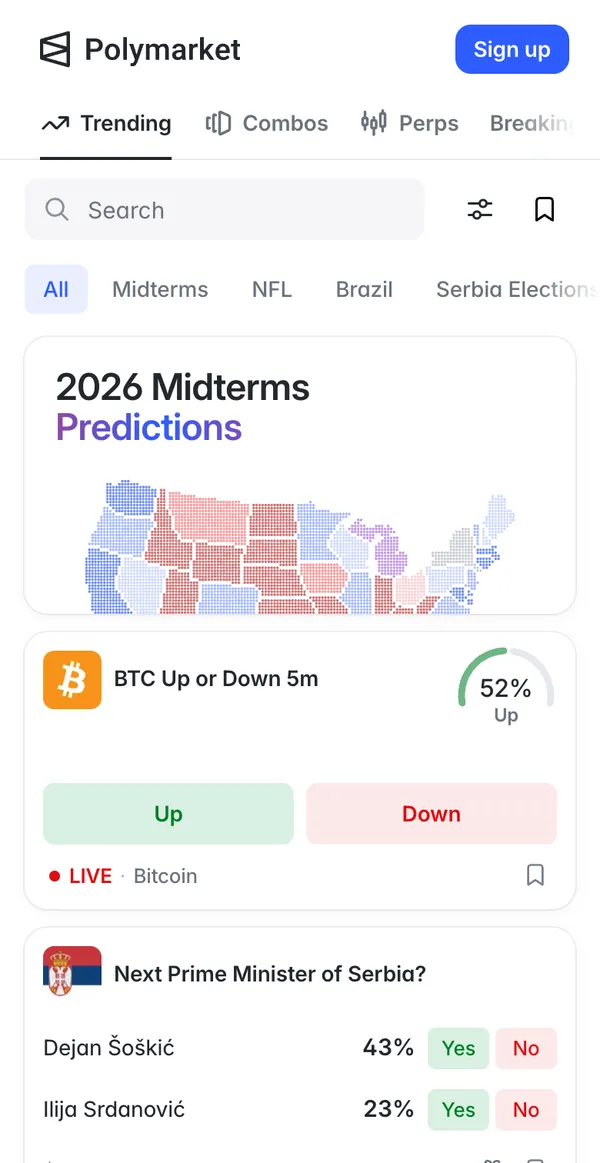
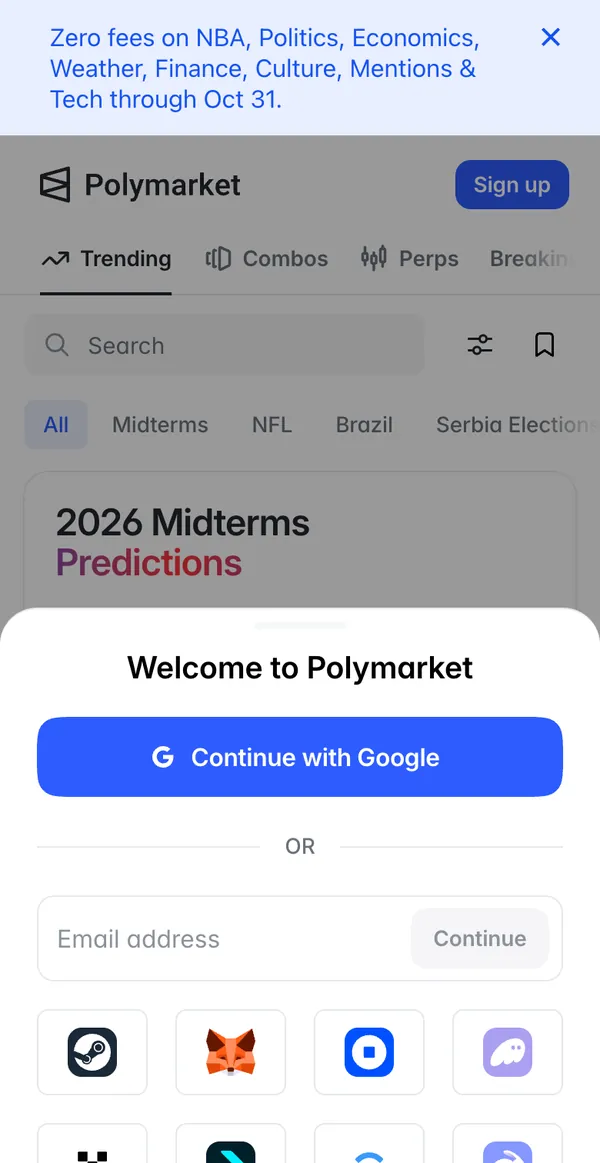
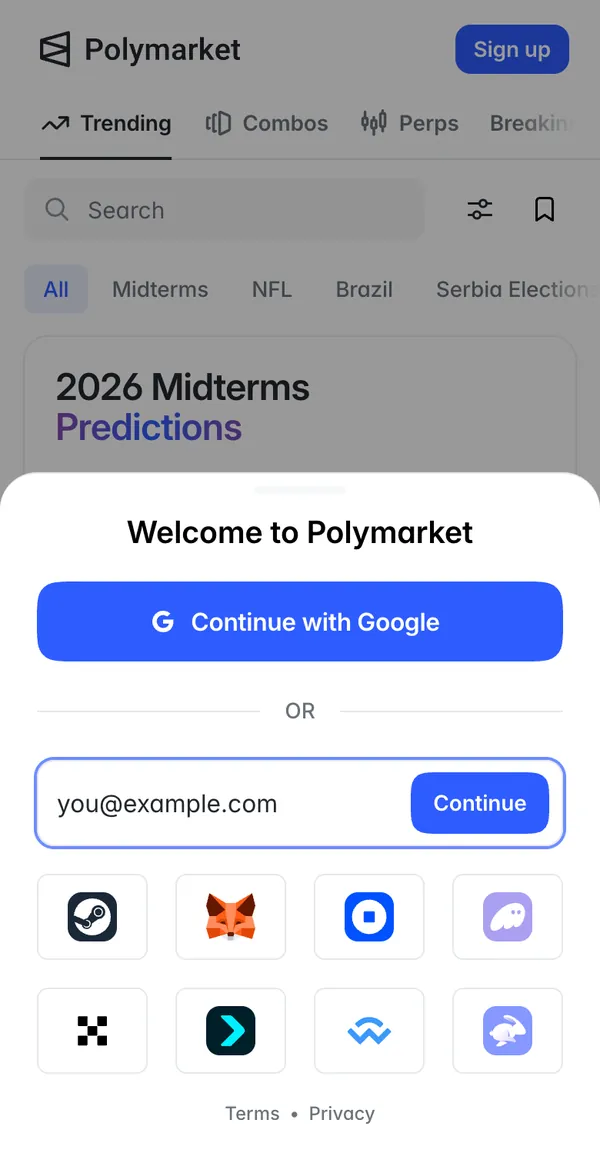
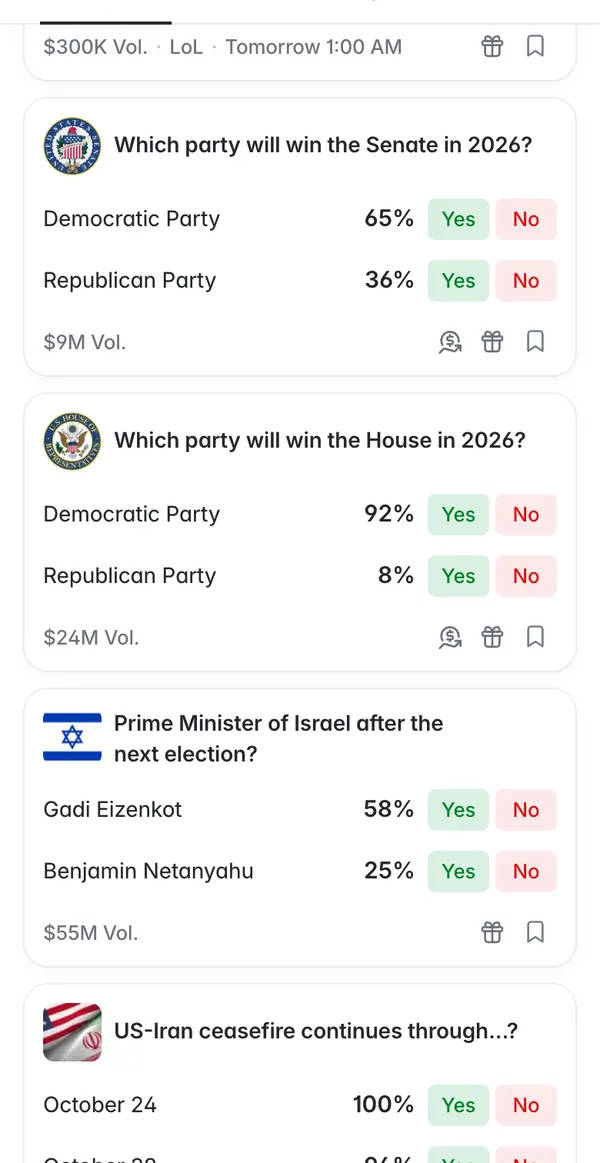
Open polymarket.com and tap Sign up Choose how to sign in Enter your email and tap Continue Find a market and tap Yes or No Open the market and tap Buy Yes Before trading: read the Rules Enter the amount Check “To win” and tap Trade
● RECStep 1/ 8
  1. Open polymarket.com and tap Sign up

    Top right corner. Check that the address is exactly polymarket.com, with no extra letters.

  2. Choose how to sign in

    Continue with Google, type an email or connect a wallet. Google or email is the simplest: a wallet is created for you automatically.

  3. Enter your email and tap Continue

    Polymarket sends a one-time code. Enter it and you're in. Then top up your balance (the deposit scheme is right below).

  4. Find a market and tap Yes or No

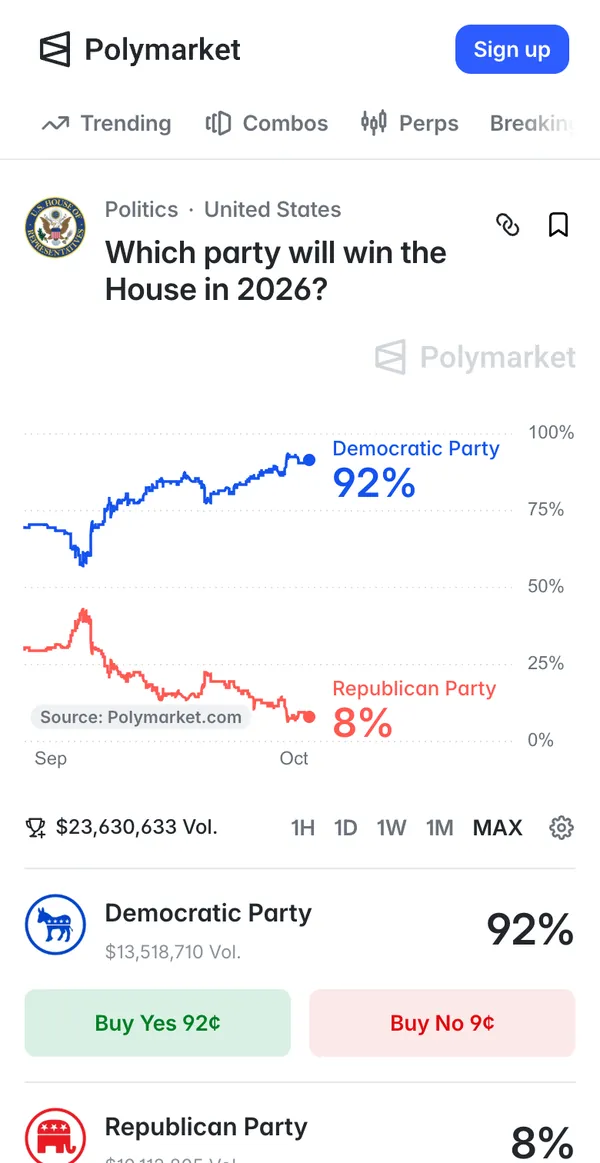
    Each row is its own market. Here: will the Democrats win the House? The big 92% is the midpoint between the best buy and sell orders. You pay the price on the Buy button, usually a little higher.

  5. Open the market and tap Buy Yes

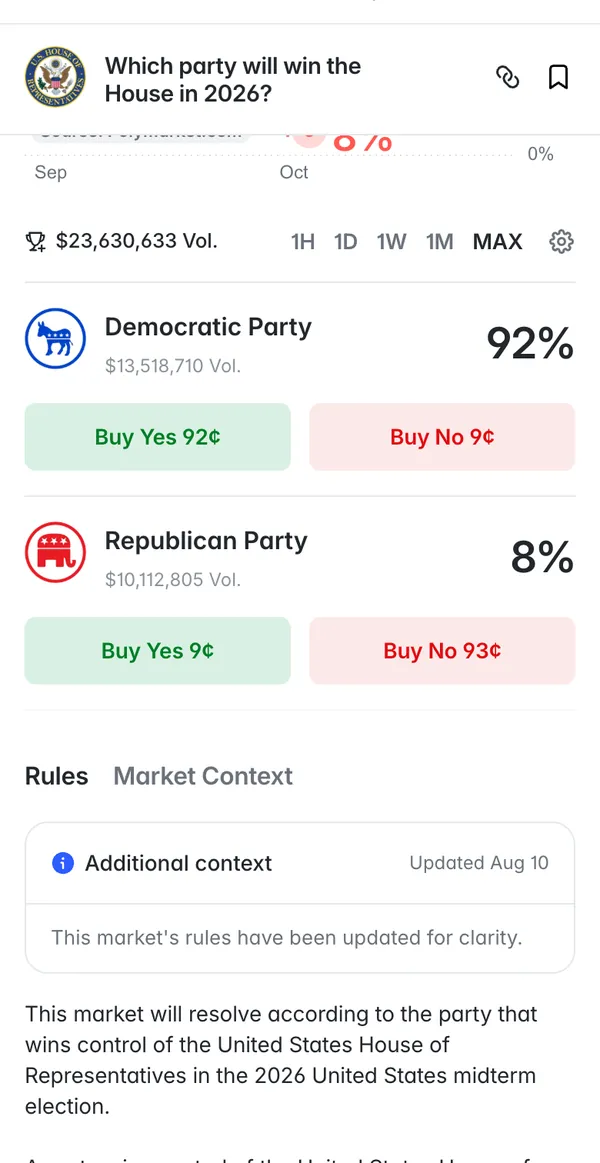
    Look at the chart and the volume first. Buy Yes and Buy No show the current price of each side.

  6. Before trading: read the Rules

    Scroll down to the resolution text and read it to the end before you press Trade (chapter 5).

  7. Enter the amount

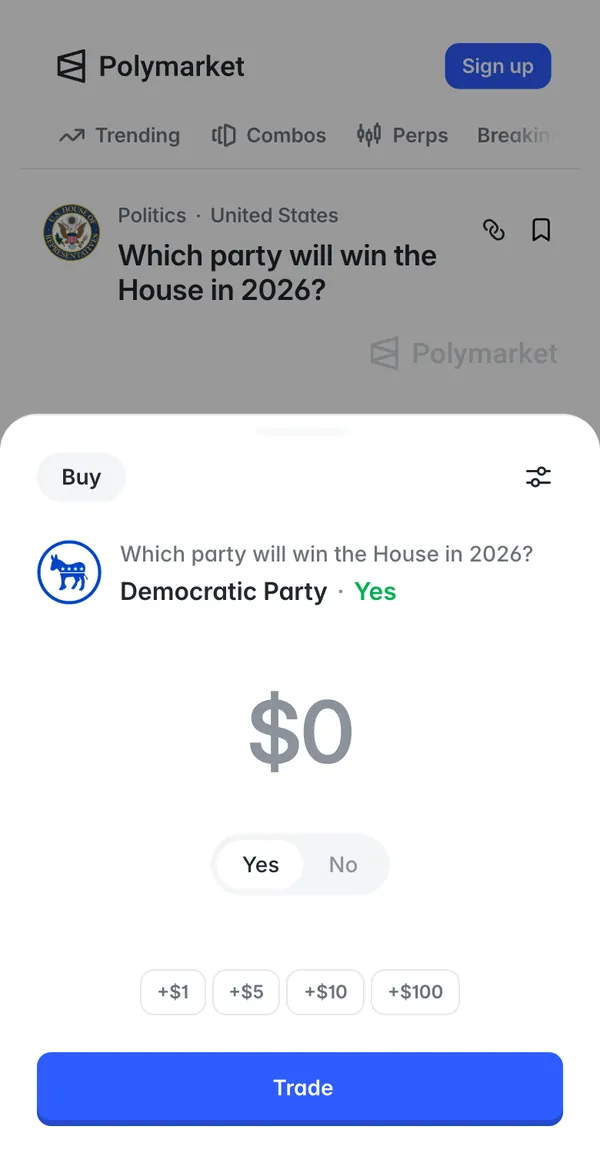
    The trade drawer opens. Type an amount or use the +$1 / +$5 / +$10 buttons.

  8. Check “To win” and tap Trade

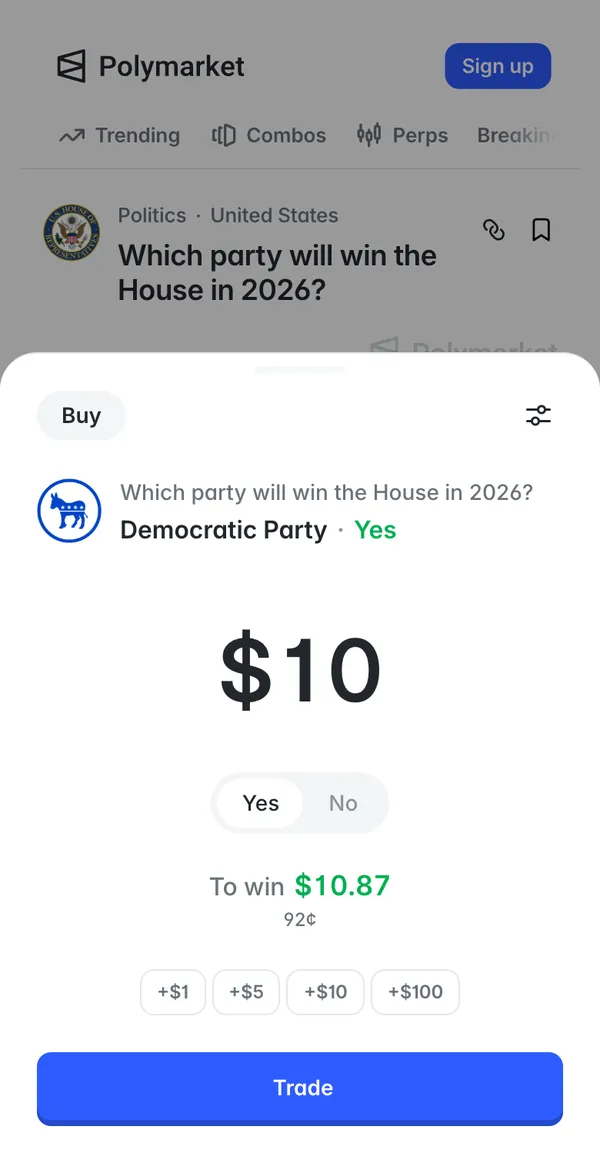
    This is a market buy at 92¢: $10 turns into $10.87 if YES wins, +8.7% before the taker fee, for risking the whole $10. That's the “sure thing” trap from chapter 2. For your own first trade, use a limit order on a market priced nearer the middle.

RECReal screenshots of the Polymarket mobile site taken on October 26, 2026 (a temporary promo banner was cropped out). The interface and prices change over time.

Your balance shows in dollars. Under the hood it's pUSD, Polymarket's dollar token, fully backed by USDC, a stablecoin built to stay at $1. You deposit USDC (or another supported token) and the conversion is automatic. The one crypto choice you make is the network, the blockchain your money travels on: Polygon, Base, Arbitrum, Solana and others.

Exchange or walletor a card · Coinbase
USDC on a supported network PolygonBaseArbitrumSolana
Your personal deposit address0x••••…••••
Balance in pUSD$50.00
SC 04Send USDC once. The conversion to pUSD happens automatically.
  1. Create an account. An email or a Google account is enough, and a wallet is created for you automatically. If you're already into crypto, you can connect your own wallet (MetaMask and others).
  2. Fund your balance. Have crypto? Tap Deposit, choose Transfer Crypto, pick USDC and a network, then send from your exchange on the same network: a wrong-network transfer can't be undone. No crypto? Pay by card; the provider takes a few percent and may ask for ID. Send a $5 test first on a cheap network such as Polygon, Base or Solana: on Ethereum the minimum is higher, and smaller deposits stay pending.
  3. Pick a market. Run it through the checklist below, then read the rules under the chart all the way to the end. Chapter 5 explains why this matters so much.
  4. Make your first trade for about $2. Limit orders usually need at least 5 shares, so 5 shares at 40¢ or less cost $2 or less. The trade's job is to walk you through the whole cycle by hand: buy, watch the price, then sell or wait for resolution.
How to pick your first market
  • Ends soon. It resolves within days or a few weeks, so you see the full cycle.
  • Tight spread. Best bid and best ask are 2-3¢ apart or closer.
  • Priced between 15¢ and 85¢. Room to move both ways, and no “sure thing”.
  • One clear source. The rules name a single source of truth, such as an official site or a data feed.
  • A topic you follow. You can form your own estimate before you look at the price.

Skip markets on secret decisions such as awards, verdicts and military moves. Someone may already know the answer (case 07).

Your scene
Sign up and send a test depositSign up with email or Google in about a minute, then send a $5 test deposit on a cheap network before the rest of your $20.
Create your account →

Chapter IV

Orders and the order book

“The price you see is not always the price you get.”

Polymarket is a full exchange with an order book. Once you can read the book, you stop gambling and start trading.

Market order

“Buy now at the best available price.” Fast, but on a thin market the price can run away from you. That's called slippage. On most markets a market order also pays a taker fee.

Limit order

“Buy only at my price or better.” The order sits in the book waiting for a seller. Slower, but you control the price, and a resting order (maker) pays no fee and even earns rebates.

Spread

The gap between the best buy and sell prices. YES: buy at 58¢, sell at 54¢, so the spread is 4¢. That's your hidden cost of getting in and out. The % on the market card is the middle, 56%, or the last trade when the spread tops 10¢.

Example. On a popular election market the spread is 1¢, so a market order costs you pennies. On an obscure market about the weather in Oslo the spread is 12¢: you buy at 46¢ and can only sell at 34¢, which puts you 26% down the moment you enter. Use only limit orders there, or skip illiquid markets altogether.

Fees: on most markets the taker pays, meaning whoever fills against an order already in the book, by market order or an instantly filled limit. Formula: shares × rate × price × (1 − price), or $1-1.75 per 100 shares at 50¢, by category. Geopolitics markets are fee-free. The maker, whose order rested in the book, pays nothing.

One more important detail: you don't have to hold a position until resolution. You can sell your shares at any time while there are buyers. Bought YES at 40¢, news broke and the price hit 65¢? You can lock in +62% within an hour without waiting for the outcome.

PriceShares
Sell orders (asks)
62¢300
60¢450
59¢200
58¢120
Spread4¢
57¢Your limit order · maker · no fee200
54¢150
53¢400
51¢600
50¢900
Buy orders (bids)
Market buy500 YES
120 × 58¢200 × 59¢180 × 60¢
Average price59.1¢
Slippage vs best price+1.1¢

+ taker fee on top

SC 05A market order eats the book level by level. A limit order inside the spread waits and pays no fee.
Placing a limit order in the app
  1. In the trade panel, switch the order type from Market to Limit.
  2. Set your price and the number of shares, at least 5. Five shares at 38¢ cost $1.90.
  3. Your open order appears under the order book and in Portfolio. Cancel it there with the red x.
  4. It can fill in parts, a few shares at a time. Sports markets cancel resting orders when the game starts.
  5. A buy limit at or above the best ask fills at once, at least in part. That part makes you a taker, so you pay the taker fee on it.
Your scene
Measure a real spreadOpen one market, find the best bid and the best ask in its order book and write down the gap.
Check an order book →

Chapter V

Resolution: who decides the outcome

“The fine print decides who gets paid.”

This is the most underrated chapter of the course. A market pays out strictly by its rules, the text written in its description. Fairness and headlines play no part in it.

Most markets resolve through the UMA optimistic oracle. A proposer submits the outcome and posts a bond, opening a 2-hour challenge window. No dispute: the result is final. Anyone can dispute with a matching bond, usually $750. A first dispute triggers a fresh proposal; a second sends the question to a UMA token-holder vote after a 24-48 hour debate, about 4-6 days in total.

  1. The event ends
  2. A proposer submits the outcome and posts a bond
  3. 2-hour window: anyone can dispute
  4. No dispute: the result is final, winning shares pay $1Disputed twice? A UMA vote, 4-6 days in total
SC 06How most markets resolve: through the UMA optimistic oracle.
A classic trap. “Will leaders A and B meet before March 31?” The meeting is announced, every outlet says “it's settled”, and YES flies to 95¢. The rules count only a meeting that has actually taken place, and it moves to April 2. Resolution: NO. Holders of the “obvious” YES lose everything.
Summit confirmed

The meeting is announced. Every outlet says: “It's settled.”

YES 95¢
Mar31
→
Apr2

The meeting gets moved to April 2.

YES 95¢
NO

March 31 passes without a meeting. Resolution: NO.

YES 95¢
SC 07Three frames that cost YES holders everything.

So before any trade, answer three questions:

  1. What exactly has to happen? Word for word, per the rules: which event, in what form.
  2. By when, and according to which source? Deadline, time zone, source of truth (an official announcement? a specific website? whose data?).
  3. What edge cases are possible? Postponement, cancellation, partial fulfilment, ambiguity. How do the rules treat each of them?

Your turn · 3 cases

Rules detective

Three cases, one tap each. Read the rules. Read the news. Then call the resolution.

Case 1 of 3Made-up example

The tiny cut

Market rules

Resolves YES if the central bank lowers its key rate by any amount at its March meeting, according to its official statement.

What happened

Rate cut of just 0.1 point: “a non-event”, analysts shrug
UpdateOfficial statement: key rate lowered from 4.50% to 4.40%

How does this market resolve?

Clarifications. Polymarket can add “Additional context” to a market's rules after trading starts. The title only describes the market; the rules, with any clarification, decide it. A clarification clears the order book and cancels resting orders, so check your open orders when one appears.

Getting paid and getting your money out
  • Sell before the end. In the market's trade panel, sell your shares at the current bid, or set your own price with a limit order. The cash returns to your balance when the order fills.
  • Redeem after resolution. Trading stops, and each winning share is worth $1 (50¢ in a rare 50-50). If the payout doesn't reach your balance on its own, claim it in Portfolio; there's no deadline. Losing shares are worth zero.
  • Withdraw. In Portfolio tap Withdraw, paste the recipient address from your exchange, choose the token, amount and network, and confirm. Use a network your exchange accepts for that token, and send a small test first.
Your scene
Read one market's rules end to endAnswer the three questions above from one market's rules before you look at its price.
Read a market's rules →

Chapter VI

Five strategies to learn

“An edge is something you know that the price doesn't.”

There's no magic button: every strategy trades your time, knowledge or speed for an edge over other traders. Here are five approaches worth starting with.

1. Niche expertfor beginners

Trade only what you know better than the average trader: your sport, crypto, esports, space launches. Niche markets are often priced by people who read a single headline, so your knowledge of the context is your edge.

Risk: the illusion of expertise. Being a fan of the team gives you bias, and fans tend to overrate their own side.

2. Value approachfor beginners

First estimate the probability yourself, without looking at the price. Then compare. Your estimate is 60% and YES costs 45¢: a 15-point margin, so you can buy. Estimate 60%, price 58¢: no edge, walk away. Risk a fixed small share of your bankroll on each trade (2-5%).

Risk: overconfidence in your estimates. Keep a trade journal and check your forecasts against reality for at least a month.

3. News tradingintermediate

On big markets, news hits the price within seconds, and most of that speed belongs to bots. Your realistic chance is slow niche markets, such as a minor league or a local election, where fewer people watch and repricing can lag. Read the original source before you buy.

Risk: fakes and planted stories. One buy based on an unverified screenshot can cost weeks of profit.

4. Trade the price swingintermediate

Buy YES at 40¢ before a debate, an earnings report or a match. If the hype lifts it to 60¢, sell for +50% and the result stops mattering to you. The mirror case: it slides to 25¢ and you're about 38% down, plus the spread and fees you pay once going in and again going out.

Risk: the price can move against you faster than you can exit. Decide in advance where you'll cut the loss.

5. Arbitrage and limit orders inside the spreadadvanced

When the Buy prices (best asks) of YES on all outcomes in one event sum to under $1, buying the full set locks in a profit if fees don't eat the gap. Check the set is complete: an “Other” line, names added later or different rules per outcome break the math. Second play: rest limit orders inside a wide spread as a maker, with no fee and with rebates.

Risk: arbitrage vanishes in seconds, and partial fills leave you with a lopsided position. Practice with small amounts first.

Your scene
Choose your nichePick one category you know better than most traders and log your own probability on three of its markets this week.
Explore categories →

Chapter VII

Risks and beginner mistakes

“Stay in the game long enough to get good.”

Bad position sizing kills more deposits than bad forecasts. Two traders, the same markets, the same 60% hit rate. The only difference is how much they put on each trade:

Bankroll 40 trades → Start 2-5% per trade All-in on every trade Busted
SC 08Same forecasts, different sizing: one is still in the game, the other is out after a single miss.
01“Sure things” and longshots

At 95-99¢ you risk the whole position for +1-5%, and one black swan wipes out 19 to 99 wins. Cheap longshots are no shortcut either: in a September 2026 study of 588 million Polymarket trades, buys under 10¢ lost 19.3¢ per dollar, while buys at 90¢ or more earned 0.83¢. Grouped by event, though, longshots came out 4.1¢ ahead, and sports showed no such pattern. The price alone is never the edge.

02Whole bankroll on one trade

Even at 80% confidence you lose one time in five. Rule: no more than 2-5% of your bankroll per market, however “obvious” it seems.

03Unread rules

Resolution follows the text of the rules, whatever you feel about the outcome. Chapter 5 exists for a reason.

04Illiquid markets

A wide spread quietly takes 10-20% on the way in and out. Check volume and the order book before you trade.

05Trading on emotion

Chasing losses and betting on your favourite team are casino patterns. A trade journal and a daily limit work better than willpower.

06Phishing and fake sites

Only polymarket.com, and never share your seed phrase or private key with anyone. Real support will never ask for them.

Two more things. First, Polymarket's availability and the taxation of winnings depend on your country, so check the local rules in advance; that part is on you. Second, pUSD and USDC are stablecoins that live in crypto infrastructure: keep a working amount on your balance and your savings elsewhere.

Your scene
Write your limits downThree numbers: your bankroll, a 2-5% cap per position, a daily loss limit. While you learn, use minimum 5-share orders.
Place your first order →

Chapter VIII

Based on true events

“Every rule in this course was paid for by someone.”

Everything below happened with real money on Polymarket, and each story links its sources so you can check every number. Read them as case files: what happened, and which rule from this course it proves.

Who actually wins

An on-chain analysis of about 2.5 million Polymarket wallets (April 2026) found that 84% of them lost money, only 2% made more than $1,000 and just 0.033% made more than $100,000. A separate Solidus Labs study of political markets found that well under 1% of profitable wallets took half of all the gains.

Lesson: the default outcome is a small loss. Your first $20 buys tuition: about ten $2 trades, each a full lesson in entry, exit and resolution, plus a journal that shows whether you have an edge. Trade bigger only when it does. Chapter 7.

Sources: The Defiant · CoinDesk

If Polymarket were 100 traders

84lost money14made a little2made over $1,000
SC 09Based on ~2.5 million wallets, April 2026. One trader can own many wallets, so the figures count wallets rather than people.

The case files

Nine stories the market paid for

Case 01Nov 2024
Big win

The neighbour poll

A French trader known as Théo put more than $30 million on Trump winning the 2024 US election across several accounts (Fredi9999 among them). He told the Wall Street Journal that polls underestimated Trump, so he paid a polling firm to ask people who their neighbours would vote for. Chainalysis estimated his net profit at about $79 million and later raised the figure to $83.5 million.

Lesson: his own poll gave him information the crowd lacked. One win can't prove an edge, even an $80 million-plus one: it was a single concentrated bet, and with a different result this would be a story about a $30 million loss. Chapters 6 and 7.

Sources: Business Standard · The Block · Chainalysis (X)

Case 02Mar 2025
Oracle

The whale vote

“Ukraine agrees to Trump mineral deal before April?” (about $7 million in volume) resolved YES on March 25 with no agreement reached. The deal was signed on April 30. A security researcher claimed one UMA holder cast about 5 million tokens via three accounts, roughly a quarter of the vote; neither Polymarket nor UMA confirmed it. Polymarket called it unprecedented yet refused refunds: it “wasn't a market failure”. Months later, UMA put Polymarket proposers on a whitelist.

Lesson: you can be right about the world and still lose to the oracle. Size positions so that one bad resolution can't break you. Chapter 5.

Sources: CoinDesk · The Block · Cointelegraph · U.S. Treasury

Case 03Jul 2025
Wording

Is it a suit?

Would Zelensky be photographed in a suit by the end of June? At the NATO summit on June 24 he wore an outfit that some called a suit and others didn't, and the rules never defined the word. Volume swelled to more than $237 million. After a dispute, the market finally resolved NO on July 8.

Lesson: if the key word in the rules can be argued about, you're betting on the arbiters' opinion. Skip it or keep it small. Chapter 5.

Sources: Decrypt · CoinDesk

Case 042024-2025
Arbitrage

The $40 million gap

Researchers from IMDEA Networks analysed 86 million bets placed between April 2024 and April 2025 and estimated that arbitrageurs extracted about $40 million from markets where the outcome prices didn't add up to $1 and from mispriced related markets. The biggest earners looked like bots.

Lesson: arbitrage (strategy 5) is real, but it's an industry. Without automation you'll mostly arrive after the gap has closed. Chapter 6.

Sources: arXiv · DL News

Case 05Oct 2025
Leak?

The night before the Nobel

María Corina Machado's chances of winning the Nobel Peace Prize hovered at a few percent. Overnight before the announcement her price jumped from 3.75% to nearly 73%, partly on bets from new accounts, at least one with no betting history. She won. The Norwegian Nobel Institute looked into it; its director said it was “highly likely” espionage.

Lesson: a sharp move with no public news often means someone knows more than you. Don't chase it, and remember who's on the other side of your trade. Chapters 1 and 6.

Sources: CoinDesk · Bloomberg · CBS News

Case 06Nov 2025
Fake volume

A quarter of the volume

A Columbia University study (not yet peer-reviewed when published) estimated that about 25% of Polymarket's volume over three years looked like wash trading, with wallets trading with themselves. At its peak it approached 60% of weekly volume; in sports markets it was about 45% of all-time volume.

Lesson: judge a market by its order book, meaning the spread and the depth. A volume counter can be inflated. Chapter 4.

Sources: CoinDesk

Case 07Jan 2026
Insider?

The Maduro trade

A new account put roughly $32,000 on “Maduro out by January 31” at odds as low as 5.5%. Hours later, on January 3, US forces captured Maduro and the account's profit topped $400,000. A congressman introduced a bill against insider trading by officials. In April 2026 the US Justice Department charged a US soldier with using classified information to place the bets; charges are allegations until proven in court.

Lesson: in markets on secret decisions (military operations, verdicts, awards) the other side may simply know the answer. That's where retail traders most often end up as the “dumb money”.

Sources: NPR · Fortune · U.S. DOJ

Case 08Jan 2026
Bots

Fifteen-minute robots

Ultra-short markets like “Will Bitcoin be up in the next 15 minutes?” turned into a playground for high-frequency bots. In January 2026 Polymarket introduced taker fees on these markets to fund rebates for makers, and traders read the move as aimed at those bots.

Lesson: in fast markets you're racing machines with millisecond reactions. A human with a phone shouldn't play that game. Chapter 4.

Sources: Cryptopolitan

Case 09Jun 2026
Timing

Sold in time, confirmed too late

Would Strategy (formerly MicroStrategy) sell any bitcoin by May 31, 2026? It sold 32 BTC from May 26 to May 31 and disclosed it in an SEC filing on June 1. Polymarket clarified that confirmation outside the time frame doesn't count; the market resolved NO, and a UMA vote upheld it on June 3. In July, two YES holders sued Polymarket in New York.

Lesson: this is question 2 from chapter 5 in action. Besides “what happened?”, ask “by when, and confirmed by which source?”.

Sources: The Block · The Block (June 4) · crypto.news

Figures are as reported by the cited sources and sometimes differ between them. None of the insider-trading suspicions in these stories has been proven in court; criminal charges are allegations. Last checked: October 2026.

New case files and course updates go out on X first. @polywhales_vip

The playbook

How the pros actually play

Patterns that keep showing up in interviews, research and on-chain data, each with a small-scale way to try it.

Let big wins pay for small losses

Domer, one of Polymarket's best-known traders and a former professional poker player: “I make a lot of bets, and lose a lot of bets.” Also: “I think I might be losing slightly more bets than I am winning, but winning more money than I am losing.” His average win beats his average loss, so win rate alone says little.

Try: in your journal, track your average win against your average loss as well as your win rate.

Sources: On Chain Times

Size each bet by your confidence

Same interview: “If you find an edge but you're not sure if it's any good, bet a little bit. If you find what you think is a big edge, bet a lot.” And the warning: “A lot of people bet way too much when they don't have an edge.” For a beginner, “a lot” still means 2-5% of the bankroll.

Try: before each trade, write down your edge in one sentence. If you can't, make it a $1 trade or skip it.

Sources: On Chain Times

Build your own data

Théo distrusted public polls and paid for his own survey. A weather trader might compare forecast models such as ECMWF or GFS with the price, after checking which weather station the rules use, and enter only on a large gap. Both have a source of probability independent of the market price.

Try: pick one niche and write down your own probability before you look at the price. Compare after resolution.

Sources: Business Standard · Laika Labs

Be the house: provide liquidity

Profits concentrate among makers: in Solidus Labs' data on political markets, 0.55% of profitable maker wallets took half of all maker gains. Makers post limit orders, pay no fee and earn rebates. Their risk is getting picked off by better-informed traders (remember the Nobel and Maduro cases).

Try: place small limit orders inside the spread on a market you know well, and cancel them before big news.

Sources: CoinDesk

Scan widely, trade rarely

Domer describes his days as “going through hundreds of markets”, adding that “nine times out of ten, I see the price, and it seems fine.” The money is in the rare tenth one. Big ideas get a second opinion: “I have a core group of people that I trust and talk to.”

Try: scan 20 markets a day and allow yourself at most one trade. Discuss the big ones with someone you trust.

Sources: MetaMask · On Chain Times

Your scene
Open your own case filePick one market, write your probability and your edge in one sentence, then compare both with the price.
Find your first case →

Final

Quiz: test yourself

Six questions on the course material. Answer honestly: the explanation appears right after you choose.

Starring

Mini glossary

Shares
Units of an outcome. They pay $1 if the outcome happens and 0 if it doesn't.
Resolution
The final determination of a market's outcome according to its rules. Payouts follow.
Oracle (UMA)
A decentralized mechanism that records the outcome and settles disputes.
Spread
The gap between the best buy and sell prices. The hidden cost of a trade.
Maker / taker
A maker's limit order rests in the book; a taker fills against it. On most markets the taker pays the fee, the maker pays nothing.
Liquidity
How much money sits in the order book. More liquidity means fairer entry and exit prices.
Edge
The difference between your probability estimate and the market price. No edge, no trade.
Slippage
A worse fill on a market order when it “eats” through several levels of the book.
pUSD
Polymarket's dollar token, fully backed by USDC. Your balance and payouts are held in it, and it can be converted back into USDC.
Bankroll
The capital set aside for trading. Size every position as a share of it, whatever your mood.
Your scene
Use the vocabulary liveOn one market, find the spread, the depth of the book and the resolution source in the rules.
Try it on a market →

Behind the scenes

Frequently asked questions

Is this a casino or trading?
Mechanically it's an exchange: an order book, limit orders, and another trader as your counterparty. What it becomes depends on you. With analysis and risk management it's trading. With emotional bets it's a casino with extra steps.
How much money do I need to start?
$20-50 is enough to learn. At first, your goal is to go through the full trade cycle while losing no more than a couple of dollars per mistake. Grow your bankroll only after a month of positive stats in your trade journal.
Are there fees?
Yes, but only for takers. As of October 2026, on most markets orders that execute immediately pay a fee of shares × rate × price × (1 − price): at most $1-1.75 per 100 shares near 50¢, and less toward the extremes. Orders that rest in the book (makers) pay nothing and share in rebates; geopolitics markets are fee-free. Polymarket itself doesn't charge for deposits and withdrawals, though card providers and exchanges may. Rates change and temporary promotions happen, so check the current fee page before you trade.
Can I exit a position before the event ends?
Yes, at any time while there are buyers in the book. Many traders never hold to resolution at all and trade price moves on news instead (strategy 4 in chapter 6).
When do I get paid if I'm right?
After the market resolves. A proposed result becomes final after a 2-hour challenge window, or after about 4-6 days if a dispute goes to a UMA vote. Each winning share is then worth $1. If the payout doesn't reach your balance on its own, claim it in Portfolio; there's no deadline. Need the money sooner? Sell your shares before resolution at the current bid.
How do I withdraw my money?
Open Portfolio and tap Withdraw. Paste the recipient address (for example, your exchange's USDC deposit address), choose the token, amount and network, then confirm. Use a network your exchange accepts for that token and send a small test first. Polymarket charges no withdrawal fee, but sending to another network or token can cost a small bridge or gas fee, shown before you confirm. Your exchange may charge its own.
Is Polymarket available in my country?
It depends on where you are. Polymarket is not available in a number of countries and regions, and the list changes: see the official list. Check it and your local laws before signing up. Complying with your country's rules is on you.
Can I use a VPN? What about the US?
US residents can't use polymarket.com; there's a separate Polymarket US app for iOS. As of October 2026, 39 countries are blocked, including the UK, France, Germany, Italy and Russia, plus regions such as Ontario, Quebec and Crimea, and the list changes. Using a VPN to get around a block breaks Polymarket's Terms (section 2.1.4). Check the official list before you deposit.
Is my money safe?
Polymarket is non-custodial: your funds sit in a wallet tied to your login. Protect that login: turn on two-factor authentication for the email or Google account you use, and never share the 6-digit code or your private key. Polymarket has no token besides pUSD, the dollar balance you trade with, and has published no airdrop date or claim page, so any airdrop “claim” link is a scam. Official channels: polymarket.com, x.com/polymarket, discord.gg/polymarket.
Do I owe tax on my winnings?
That depends on your country, and a local tax adviser is the one to ask. Your part is the records: date, market, price, shares and fees for every trade, plus every deposit and withdrawal with its transaction hash. A trade journal kept from day one covers most of it.
What are Combos and Perps?
Combos bundle several markets into one trade that pays only if every leg wins; for now they cover sports markets. Perps are leveraged contracts that track an asset's price and never resolve. This course covers neither. Skip both until your journal shows an edge on plain Yes/No markets.
Why is the course free, and what's in it for us?
The Polymarket links on this site are referral links: if you sign up through them, we may receive a share of Polymarket's trading fees under its referral program, and your own fees stay the same. Prefer not to? Go to polymarket.com directly. The course stays just as free.

Course complete. Time to practice 🐋

Theory fades within a week if you don't use it. Here is your mission: five steps from sign-up to your first trade, logged in your journal. Tick them off as you go.

Mission: your first trade0 / 5
  1. Sign up →

This is our referral link: signing up through it supports the project, and your fees stay the same. Thanks if you use it 🖤

The End

…of the course. Your own story starts with the first trade.